
I have continued to look into my ancestry for coats of arms, and I was delighted to find an especially interesting pair far down my father’s line. I’m including both in a single post because of their connection to one another long before I was around.
Full Disclosure
I wish that I could state with full confidence that these two are, in fact, my ancestors. Unfortunately, my family link to them goes back until Jesse Byrd Renfro (1785-1876) and then the documentation further back gets scant. Although it is possible that these are my real ancestors, it would be incorrect to leave the impression that this connection is clear and well-documented.
The Owsley-Poyntz Union
There was a fascinating union in 1652 when Reverend John Owsley II married Dorothea Poyntz, probably in or near Leicestershire, England (where both died many years later). If familysearch.org is accurate, the couple are my 11th-Great Grandparents on my father’s side. This marriage is especially interesting to me because both families bore coats of arms. I will first review the arms of Owsley before doing the same for Poyntz.
The Owsleys
There is extensive information on the Owsley ancestry at https://owsleyfamily.com/. There are, of course, variant spellings of the surname, including Ousley, Ouseley, Owslie, and even Housley. The variant spellings are a challenge for tracing the precise lines of heraldry, but some things are clear. I will be sure to note any uncertainties in my comments here.
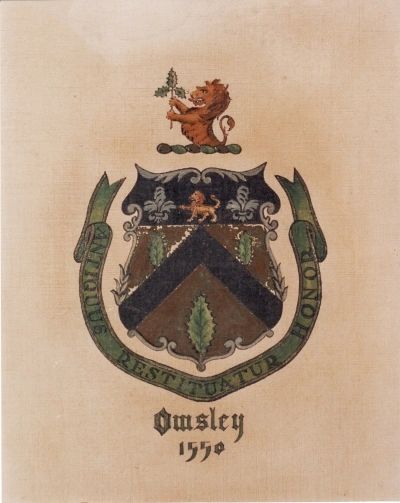
According to Harry Bryan Owsley in The Owsley Family in England and America 1635-1890, the Owsley arms were certainly held by Newdigate Owsley (1660-1713; my 10th-Great Uncle if familysearch.org is accurate). This is clear because they are referenced in correspondence he sent. We also know that the arms are documented under the “Ouseley” spelling for Visitation records for the Ouseleys in Northamptonshire dating from 1564, 1610, 1613 and 1618.
Although it is not clear how the Northamptonshire Ouseleys are related to those who were in Leicestershire, the description of the arms is striking. Both shields have the same blazon (description), but the crests are very different. Because crests became a later tradition, it seems likely that the two Owsley (or Ouseley) lines shared a common ancestor.
Given the age of the documented arms, and Newdigate’s documented use thereof, it can be said with high confidence that Newdigate’s father, the Reverend John Owsley II (1630-1687; my 11th-Great Grandfather, again, if familysearch is correct) also bore the arms (Newdigate was the brother of Thomas Owsley, supposedly my 10th-Great Grandfather.). Thus, there is a direct line to these arms, even if by English tradition there is no claim to them (due to the traditions regarding daughters inheriting arms – my father supposedly comes from Thomas’s daughter, Jane Owsley [1681-1734]).
The Owsley Coat of Arms
The arms of Owsley are well documented in multiple sources.
Burke’s General Armory cites them under the Ouseley variant spelling (although with minor details differing from other sources).
They appear under “Owsley” in Burke’s Commoners of Great Britain and Ireland (which is now known as Burke’s Landed Gentry).
The crest is cited in Fairbairn’s Book of Crests of the Families of Great Britain and Ireland, again under “Owsley.”
Furthermore, the arms appear on a marble monument at St. Mary’s Church in Leyton, Essex County, where some of the Owsleys are interred (see image [credit]; the shield is on the top of the monument). The monument was made in the early 1700s. The crest is absent from the arms on the monument, but that is not unusual.
They appear in American documents as well:
The Owsley coat of arms is cited in Matthews’ American Armoury and Blue Book (1907).
It also appears in Crozier’s General Armory.


The Owsley Arms Blazon
In each of the cited sources, the Owsley (et al.) coat of arms is blazoned as follows:
Shield – Or, a chevron sable between three holly leaves vert, on a chief of the second a lion passant or, between two fleurs-de-lis argent.
Crest – a demi-lion rampant or, holding a branch of holly vert.
In simpler language, this means that the shield is gold (depicted as yellow in paintings) with a black chevron that separates three green holly leaves. On a black bar at the top of the shield is a golden lion walking between two silver (white in a painting) fleurs-de-lis. The crest is the upper half of a golden lion, standing and ready to strike, holding a green branch of holly.
Although not mentioned in any blazon, the motto in this case reads “Antiquus Restituatur Honor,” which is Latin for “Ancient Honor Restored.” Mottoes were often not explicitly part of the arms and were changeable based on the bearer’s wishes. I include it here merely as homage to the painting dated 1550 above.
Notes on the Appearance
The charges in English heraldry do not generally have specific meanings, although it is fair to venture that the holly leaves and branch were linked to the family’s history in faith. Some have argued that holly often implied peace and goodwill, among other attributes.
Similarly, the fleurs-de-lis do not have a distinct meaning, but they were often linked to the Holy Trinity, given the three petals. Whatever the origin of these charges, it seems likely that the Owsley clergy would have favored these religious interpretations.
The gold bars on the helmet are typically reserved for gentry. Because there was a strong history of Owsleys as clergy, including John Owsley II, and because they are listed in Burke’s Landed Gentry (as noted above), the gold bars are appropriate here. Furthermore, because the Owsley family is connected to the Poyntz family (as I will explain below), it is highly likely that the gold bars would be present.
The Poyntz Family
As I noted above, Reverend John Owsley and Dorothea Poyntz married in 1652. Dorothea’s Great Grandfather was Sir Nicholas Poyntz of Iron Acton, Sheriff of Gloucestershire (1535-1585). The Sheriff’s office had been previously held by Nicholas’s father (who died in 1557). In fact, the Poyntz family was an important one in England as far back as the 1200s, when Hugh Poyntz was the Lord of Curry Mallet (read more about the Poyntz history in that position here). Lord Poyntz was one of the signatories of the Baron’s Letter to Pope Boniface VIII in 1301. That letter was a repudiation of the Pope’s claim of feudal authority over Scotland and supported the rights of King Edward I.
Interestingly, there are two lines to the Poyntz name on my father’s side of the family (again, if familysearch is accurate). Dorothea’s grandfather was John Poyntz (1577-1615) whose mother-in-law, Mary, was also a Poyntz (died in 1591). Thus, John and his wife, Ann Sydenham (1582-1634) were second cousins twice removed. They were related to one another through Robert Poyntz (1450-1520).
For much more information on the Poyntz genealogy, please see Historical and Genealogical Memoir of the Family of Poyntz by Sir John Maclean.
The Poyntz Coat of Arms
Given their long history as an important and powerful family in England, it comes as no surprise that the Poyntz coat of arms is well documented. The earliest known official documentation of the arms is of course on the Baron’s Letter that includes Hugh Poyntz’s seal. Then, it is documented in the Visitation of Gloucester of 1623, and so on. It is documented in many other later sources as well, such as Berry’s Encyclopaedia Heraldica (Vol. 1), and others.
Given their age, it is also not surprising that they are very simple arms:
Barry of eight or and gules
In simple language, this means “eight bars alternating between gold and red.”
There is no original crest noted for the Poyntz arms, which is likely again due to its very old origin. Again, this coat of arms was clearly documented in 1301, and crests were not widely adopted until the 1300s, primarily to help distinguish arms from other, similar patterns.
Another striking thing about these arms is the lack of charges (symbols or objects) on the shield. The Owsley arms, in contrast, has holly leaves, a lion, and two flours-de-lis. These charges became more common over time after original variations of the standard shield patterns were harder to come by. They helped to distinguish shields from one another. Again, the total lack of charges in the Poyntz arms is a further demonstration of their antiquity.
As noted in the Owsley arms above, the gold bars on the helmet of this coat of arms are entirely appropriate because of the high offices and status held by various Poyntzes throughout the centuries.

Closing Thoughts
Not only are both the Owsley and Poyntz arms tied to influential English families from many centuries ago, but these are also commemorative of a marriage that resulted in hundreds of progeny. I thoroughly enjoyed looking into their origins as much as I enjoyed finding their connections to each other. I am intrigued by the idea that they may also be connected to me, but I am disappointed that I may never know for sure. I may not have a right to claim these arms as my own, but I will look upon them with admiration and reverence for Reverend John Owsley II and Dorothea Poyntz.